Gravity(Attraction) of Kyoto 36 The Evolving Shokado Bento ~Kyoto Kitcho Shokado Bento
Yoshie Doi
 |
 |
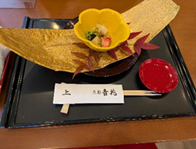
Photographed on 4th Feb. 2026 Kyoto Kitcho Shokado store
 |
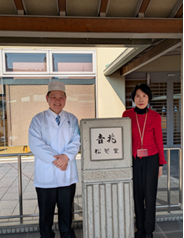 |
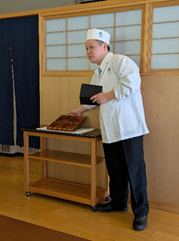
Chef Tatsuya Doi, Kyoto Kitcho Shokado Branch
He gave us an explanation of the Shokado bento.
With the global boom in Japanese cuisine and the subsequent boom in bento boxes, bento boxes have become popular around the world. The other day, I had the chance to try a Shokado bento, which evolved from a portable lunch box from the Showa era into an elaborate tea ceremony-style meal for entertaining guests. When I visited for the first time in about 10 years, the Shokado bento had evolved even further.
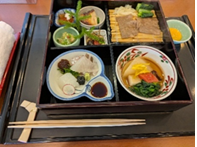
When we open the lid of the Shokado bento, steam rises and two slices of Japanese Black beef lie on a wooden slatted board, whetting our appetite with their delicious aroma. Beneath the slatted board, iron oxide has been immersed in hot water, creating a surprising effect of steam rising from it (see photo top right). The Shokado bento is housed in a container divided into cross sections, making it a symbol of Japanese bento culture.
In 1933, Yuki Teiichi (founder of Kitcho) found a square vessel placed in a corner at a tea ceremony held at the former site of Shokado Shojo. It was 3.5cm high, divided into a rectangular shape, brown with ink paintings on three sides and metal fittings on all four sides. It was originally used as a container for seeds, medicine, or small items.
During the Kan’ei era in the early Edo period, Shoka Shojo, a monk who was also a calligrapher and painter, used compartmentalized boxes used by farmers to store seeds and other items as paint boxes and medicine containers. Time passed, and during the Showa era, Yuki Teiichi, the founder of Kitcho, wondered if these could be used as cooking containers, so he inherited one of these and brought it home, where he made many improvements to turn it into a lunch box. He reduced the dimensions, increased the height, and made it slightly deeper, added a lid, and arranged food in the four rice-field shapes in a balanced manner. He used it for dim sum at tea ceremonies, where it was very well received.
The Mainichi Shimbun featured it as an “Kitcho appetizer,” and the name Shokado bento became a hot topic and spread. After the end of World War II, the Shokado bento spread and is now commonplace.
Yuki Teiichi did not register a trademark for this Shokado bento so that anyone could make it. The difference between a makunouchi bento and a Shokado bento is that makunouchi refers to the intermission before the next performance begins, and the origin of the bento is the meal eaten during this time. The name makunouchi bento became established in the mid-Edo period. The basic components of this bento are a rice ball shaped like a rice ball and side dishes.
The rice balls are sprinkled with sesame seeds, and standard side dishes without soup include dry fried foods, pickles, simmered foods, grilled fish, omelette, and fish paste.
On the other hand, the Shokado bento becomes a single dish when soup is added. The arrangement of the Shokado bento at Kitcho is as follows: the mukozuke is at the back right, the gosai is at the back left, the simmered dish is at the front left, and the rice is at the front right. This is the standard arrangement for kaiseki cuisine.(Continued next time)
The end of document
Translated by Masami Otani
