Gravity(Attraction) of Kyoto 35
In Memory of Professor Yusai Why can only the Emperor wear korozen dye?
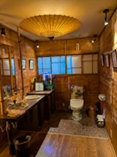
A Tea Room-Style Toilet: Arashiyama Yusai Tei Yoshie Doi
 |
 |
 |
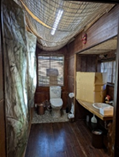 |
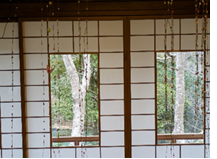
Arashiyama Yusai Tei, photographed on 8th Feb. 2026 Umbrella Toilet Goldfish Toilet
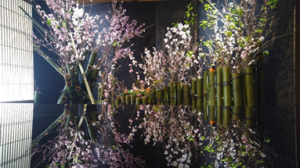
Photo taken on 29th March 2022 at the Kawabata Room at Arashiyama Yusai Tei.
A cherry blossom arrangement called “Ouun” (cherry blossom clouds) is displayed in the study where Yasunari Kawabata wrote “Yamano Oto:The Sound of the Mountain.” (This was Yusai Tei’s idea.)
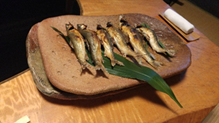
24thAug.2021 : Professor Yusai is treated me to sweetfish caught in the Oi River
 |
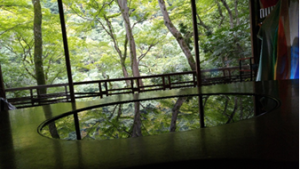 |
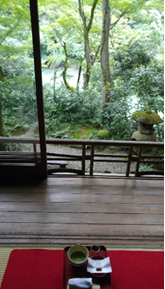
24th Aug.2021, Arashiyama Yusai Tei (Enjoy the tranquility of listening to the sounds of the mountains and the river)
The green of the Oi River reflected in the water
One day in February, I visited Arashiyama Yusai Tei. It was a cold day. I went to meet Yusai Sensei’s wife, Emi. It is truly sad that Yusai Sensei passed away last year.
The dyeing art gallery was closed at this time. It will reopen in April. The only things that were open were the tea room-style toilet and the guest room; the rest of the rooms were under restoration.
I first met Professor Yusai in 2001 when I established Kyo-Suzume and visited him to be a lecturer for a course called “Creating a world-class brand from Kyoto’s water” in the Kyo-Suzume School’s “Kyoto Water Story” curriculum.
In the fall of 2001, I visited a workshop near Kodaiji Temple, and the three of us, including the person who introduced me, had a lively conversation for five and a half hours.
Professor Yusai, who succeeded in restoring the Heian period korozen dyeing technique by creating water that was as close to ancient as possible, began by creating water that was as close to ancient as possible. He made the water by placing binchotan charcoal and oyster shells in an unglazed earthenware jar.
I once had the opportunity to try the water, as I wanted to drink it. It was made from Kyoto’s tap water and groundwater. Kyoto’s groundwater is mellow, and it dyes clothes quickly and deeply at low temperatures. This is one of the reasons why dyeing crafts have developed in Kyoto.
Since the Heian period, the costumes worn by Emperors at the highest ceremonies, such as enthronement ceremonies, are called “korozen” (yellow lacquer dye), and in the sunlight, the outside appears golden brown to crimson, while the inside appears bright red like the sun; this is an absolute taboo color.
The Engishiki, a code of conduct from the Heian period, states that wearing yellow korozen dyed clothing was banned in the 18th year of the Engi era (918). For many years, I didn’t understand why it was banned, but Professor Yusai’s explanation made it all clear to me.
In the 11th year of the Kōnin era (820), Emperor Saga issued an imperial edict stating that only the Emperor should wear korozen dyed at important ceremonies and meetings. From that time on, the color korozen dyed became widely known, sparking a huge royal boom among the general public, just like today.
Later, in the 900s, wearing this korozen dyed became popular in the capital, and common people were banned from wearing it. From that time on, korozen dyed became known as an absolute taboo color. It has the characteristic of changing color when exposed to light, creating a shining, translucent color.
In ancient China, emperors wore colors that shone brighter in the sunlight as a symbol of their authority. Following this example, in Japan, from Emperor Saga onwards, korozen dyed became a color that only the emperor could wear.
Before this course, the students had visited the studio as part of a fieldwork visit, so they were familiar with the korozen dyed process. Since then, the studio has moved several times, and they finally found their current studio in Arashiyama.
Before they moved there, somehow we got onto the topic of toilets, and I introduced them to a friend who makes painted toilets made of Kiyomizu ware, and a tea room-like toilet was completed in Arashiyama. I have organized the ” Kyoto Treasure Toilet Tour” several times, and have included this place as a stop. Of course, I have visited here many times for dyeing classes, and have had the opportunity to visit with many people, including inspection teams from Tokyo and the late Kawabata Kaoruka, chairman of the Kawabata Yasunari Memorial Association. Mr. Kawabata Yasunari also stayed in the room where he wrote “Yamano Oto:The Sound of the Mountains,” and had the opportunity to interact with Mr. Yusai.
Professor Yusai has a genius intuition, and spent about three months in Hawaii living a self-sufficient life without spending a penny. Perhaps this experience led him to catch sweetfish in the Oi River. We were treated to many delicious dried sweetfish and sweetfish dishes, and I have many fond memories of him. Please keep an eye from the afterlife on Emi-san, people at his workshop students and Kyo-Suzume.
The end of document
Translated by Masami Otani
