
Gravity(Attraction) of Kyoto 27
Earthquakes and Active Faults 1
The Zen Stone at Ginkakuji Temple, thought to calm the fury of active faults Yoshie Doi
We would like to express our heartfelt sympathies to all those affected by the earthquake in Hokkaido, Aomori and the Tohoku region.
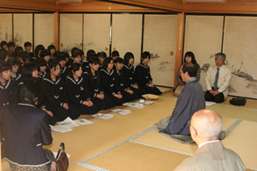 4th November 2011: Disaster Relief: Kyo-Suzume School at Soma City Koyo Junior High School 4th November 2011: Disaster Relief: Kyo-Suzume School at Soma City Koyo Junior High School |
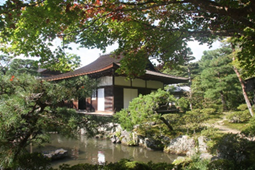 Zazen stone in front of Togudo Hall, Shoin, Ginkakuji Temple |
Japan is a country prone to earthquakes, and in a sense, it has long been a country that has thoroughly understood how to live in harmony with nature. Kyoto, in particular, is located in the Kyoto Basin, surrounded by mountains created by active fault movement. Shrines and temples have been built in places famous for the water that springs from cracks in the active faults halfway up the mountains. Kyo -Suzume has also conducted fieldwork several times, with a map of active faults in hand.
Ginkakuji Temple (Touzan Jisho-ji Temple) is located in the northeast of Kyoto, in the direction of evil spirits, and is home to the Tea Well spring. This Tea Well spring is located along a fault line, and just to the north there is a small stream that is said to have often flooded during heavy rains. Currently, a sabo dam has been built upstream, and flooding has been eliminated.
The Hanaore Fault runs through this area from Kutsuki in Shiga Prefecture along the Saba Kaido road, and the Hanaore Fault near Ginkakuji Temple branches off in a staggered pattern, running along the east side of the Ginkakuji garden and heading south past Honen-in Temple. This fault moved frequently between 800 and 1700 AD, causing significant damage.
Repeated large earthquakes have eroded the fracture zone of the Hanaore Fault, creating a valley, and the road along this valley has come to be called “Sabakaido(Mackerel Highway).” The name Hanaore Pass comes from the fact that a monk broke off a Japanese star anise branch while crossing the pass, hence the name Hanaore Fault. In Buddhism, a Japanese star anise is called a flower.
It is said that the Zen stone in Kinkyochi (Pond) in front of the Togudo (Hall) of Ginkakuji Temple and the Bentendo Hall beside the pond were placed there to calm this fault. In particular, the fault split into smaller faults near the surface, and traces of the branched faults moving up and down can be seen, indicating that the damage was severe.
The fact that the idea of calming the fury of an active fault existed during the time of the Ashikaga Shogunate suggests that nature and humans were on the same level, and it is quite moving.
Ashikaga Yoshimasa, who built the Ginkaku-ji Temple, was elected to the position of Shogun at the age of eight, and was officially appointed Shogun at the age of 15, when he came of age. Looking at his portrait, he looks like something of a philosopher.
There is no evidence that there was a plan to cover Ginkakuji with silver leaf, but during the Edo period, a guidebook called “Rakuyoumeishoshu (Collection of Famous Places of Rakuyo)” referred to the temple as Ginkakuji rather than Touzan Jisho-ji compare with Kinkakuji temple, and it quickly became known. The name Ginkakuji was a big hit compared to Kinkakuji.
It seems that the area around Ginkakuji Temple’s Ginsanada and Kogetsudai was once a pond, but Shirakawa sand flowed into it, and during the Edo period, this sand was used to create the Ginkankan and Kogetsudai.
The end of document
Translated by Masami Otani
