(日本語) 京都の引力38 桜を愛でる京言葉 散る桜、残る桜も、散る桜 花嵐
Yoshie Doi
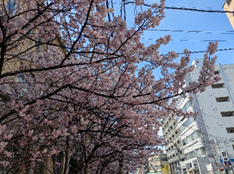 Photographed on March 10, 2026. Former Seito Junior High School. “Harumeki,” the earliest blooming cherry blossoms in Kyoto. |
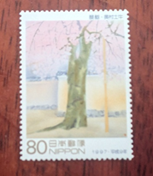 Daigoji Temple cherry blossom stamp. Okumura Togyu |
“The cherry blossoms that fall, the cherry blossoms that remain, will also fall.” This is said to be the death poem of Ryokan, a Zen monk from the late Edo period, and it is an indispensable phrase when discussing life and death. It can be interpreted as a declaration of the transience of flowers and the fact that from the moment they bloom, they bear the fate of eventually falling.
”Showing its back, showing its front, the maple leaf falls.” This is said to be a phrase that the monk Ryōkan often uttered in his later years, and it probably means that both the front and back are the same, that the maple leaf is still the maple leaf.
Cherry blossom season has arrived. In Kyoto, the early-blooming cherry blossoms (Harumeki) were the first to bloom. Today, March 10th, 2026, they were almost in full bloom. (See photo)
Kyoto Prefecture’s official flower is the weeping cherry blossom, and its official tree is the Kitayama cedar. The weeping cherry trees in the famous Maruyama Park are a popular spot for cherry blossom viewing every year.
The beauty of the diverse Japanese expressions for “flowers falling” and “flowers withering” lies in the fact that the aesthetic sense is maintained even in the moment the flowers fall, which is characteristic of the Japanese language. However, when “flowers falling” is translated into English, it becomes “flowers fall.” There are many expressions in Japanese for when flowers fall. In Japan, there is a sense of enjoying both the blooming and the falling of flowers. If you sharpen your senses, you can hear or see it. This is evidence that the Japanese people have felt the “beauty of impermanence” in the sight of falling petals since ancient times.
In Kyoto in particular, there are many expressions that describe the beauty of cherry blossoms. Also, as a botanical characteristic of cherry blossoms, unlike other plants that open their flowers towards the sun, cherry blossoms bloom facing downwards, as if inviting admiration. In rural areas, the blooming of cherry blossoms in rice paddies is considered a signal to begin farm work. The reason why there are so many rows of cherry trees along riverbanks is that their roots spread underground over three times the area of coniferous trees, reinforcing the embankment. Knowing these things together will surely make we appreciate the wisdom and aesthetics of our ancestors even more.
Among cherry trees, the Somei Yoshino variety stores the energy needed to bloom by spreading its leaves from spring to summer of the previous year, performing photosynthesis. The sugars produced through photosynthesis are stored as starch in the trunk, branches, and roots, thus accumulating energy. Then, the following spring, they all bloom at once. The Somei Yoshino cherry blossoms bloom first, and the leaves grow later. This is called “Senka-kouyo : flowers first, leaves later.”
Plum and peach trees are the same type of plant. Looking only at cherry blossoms, it might seem like they bloomed suddenly, but in reality, they had been preparing for this for a whole year.
Among cherry trees, the mountain cherry and Oshima cherry have both flower buds and leaf buds in their winter buds, so the flowers and leaves open at the same time. On the other hand, the Edohigan cherry, which is often shaped into a weeping cherry tree, also has buds, but it is said to be a species that “suppresses the opening of the leaf buds and causes only the flowers to bloom first.”
Somei Yoshino cherry trees are a hybrid created by crossing Oshima cherry trees, which produce large flowers, with Edo Higan cherry trees, which bloom only before the leaves appear. As a result, Somei Yoshino inherited the characteristics of both species: “producing large flowers before the leaves appear.”
This made it “perfect for cherry blossom viewing,” and it spread throughout the country. It’s thought that humans created a convenient cherry tree where “only the flowers bloom,” and as this spread throughout Japan, the image of “cherry blossoms = flowers first” became firmly established. In reality, it’s the leaves that determine the “quality” of next year’s blossoms.
(To be continued in the next issue)
The end of document
Translated by Masami Otani
