Gravity(Attraction) of Kyoto 26 What is genuine?
Yoshie Doi
 |
 |
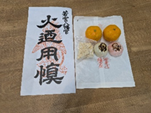 |
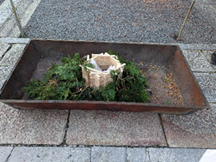
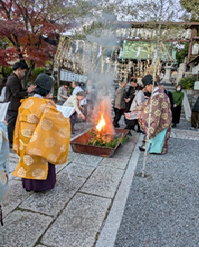
30th Nov. 2025 Wakamiya Hachiman Shrine Ohitaki Festival
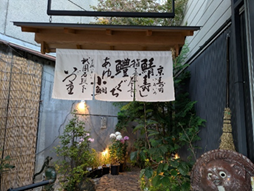
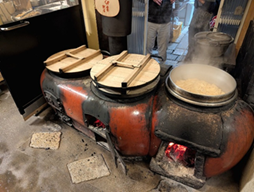
Okudosan Summit on 7th Dec. 2025 Izuju
”What is genuinec? What is happiness?” Don’t you think questions like these have become more common since the COVID-19 pandemic?
I participated in the fire-lighting festival at Wakamiya Hachimangu Shrine on 30th Nov. , and felt the power of fire to purify and regenerate. Watching the flickering flames soothes the soul. It is said that just looking at a fire gives a sense of security to the DNA of humanity.
On 7th Dec., we visited the kitchen of Gion Izuju and held an Okudosan Summit. Many heads of households who have been using Okudosan for 1025, 550, 400, and 200 years participated in the Okudosan.
Through my close relationships with the long-established businesses, I have learned that they all share a common management philosophy: “Beyond profit and loss, we strive to create the real thing.” Traditions are created out of sight and out of the blue. I was also touched when one owner said, “What we make in the okudosan is something we offer to the gods.”
I asked the members of Okudosan Mirai-shu to write the manuscript this summer, and it is now in my hands. The content is far more moving than I could have imagined, and I am currently considering how to share it.
The chef of one Japanese restaurant said, “Cooking rice in an okudosan is not just a meal, but a special time that feels like a dialogue with the blessings of nature.” He also said, “Spending every day facing the okudosan makes me grateful for the blessings of nature and reminds me of the importance of putting in the time and effort. I gaze at the flames, add firewood, and listen to the sound and aroma of the rice cooking. Through each of these actions, I am reminded that we live within the cycle of nature.”
I think there is something about fire that revives the DNA of humanity. When I watch flames, I experience my brain sensing many things. I think that through flames, we can tap into the five senses of humanity and explore new fields.
As most okudosan have been replaced by gas or electricity, they are time-consuming and expensive to maintain, making them a tool that is on the verge of disappearing. If the administration were to approve the construction of an okudosan special zone, it would be easier to pass on okudosan culture. I would like to create and propose such a concept.
One of the summit participants shared his thoughts: “It goes without saying that the okudosan produces delicious food that sets it apart from gas or electric cookers, but from the perspective of equipment, especially ventilation and disaster prevention, the costs of the additional equipment and maintenance required to maintain it are not small (Izuju said that the exhaust equipment alone would be enough to build a house). Despite this, I felt deep respect for the attitude of everyone who continues to use and preserve traditional techniques and styles, rather than simply switching to modern cooking equipment.”
One participant also commented, “I used straw as fuel, but when steaming glutinous rice in a rice cake steamer, I used dead wood. I didn’t distinguish between broadleaf and coniferous trees, but it was new to me to learn that there are differences depending on the fuel. I used straw as fuel for my everyday rice cooking, and placed it in the fireplace(coking stove)of the hearth, making the straw like as circle in an arc so that air could flow through it. We also used straw as fuel for our Goemon bath. In order to use straw as fuel efficiently and because it had to be transported a long distance to the house, I thought about how I could cook rice using as little fuel as possible in the cold winter, in order to reduce the number of times I had to transport it as much as possible.”
”The experience and kindness of the kamado engineers can be seen in the way the kamado’s exterior is designed to make it easier for users to remove containers from the cocking stove (kamado). I think the kamado is a concentrated expression of the wisdom of our ancestors.”
Izuju cooks rice, fried tofu, and shiitake mushrooms every day, and it seems they use different woods to burn depending on the ingredients, such as conifers and broad-leaved trees. It is filled with the wisdom of our ancestors and the wisdom of life.
In order to protect and pass on the familiar cooking utensil, the Okudosan, I believe that Kyoto must lead the way in Japanese culture, which knows that eight million gods reside in fire, water, wood, and stone.
We would like to continue to discover and spread Kyoto culture and the culture of daily life from places close to us.
The end of document
Translated by Masami Otani
