
Gravity(Attraction) of Kyoto 25 From drinking matcha to eating matcha: Development of tea dumplings
Yoshie Doi
 |
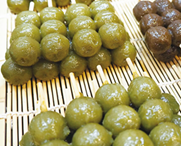 |
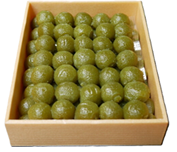
Whenever I go to Uji, there’s a tea dumpling shop that I’ve always visited since ancient times. Nowadays, tea dumplings are a famous Kyoto specialty, and I’m sure you’ve tried them at least once. Tea dumplings were invented over a period of three years during the Taisho era. The challenge was to create a Japanese sweet that was unique to a tea-producing region. And so, bite-sized tea dumplings were born in 1919. From the Taisho era through the beginning of the Showa era, tea dumplings became established as a souvenir.
The tea dumplings were invented by Suchimankichi, the previous owner of the main branch of Ochaman, and although production was temporarily suspended during the war, production resumed after the war around 1949 or 1950. In order to revitalize the local area, Suchimankichi, who developed the product, opened it up to fellow craftsmen without registering a trademark.
Ochaman is located about a five-minute walk from JR Uji Station, and I was surprised at how delicious it was the first time I tried it. They take the time and effort to make their bread, which is additive-free and uses hand-kneaded rice flour, so you can enjoy the same taste as when they first opened.
Of the seven dumpling shops in Uji, this is the only one that still makes its dumplings by hand. They are characterized by a subtle flavor and softness that cannot be achieved with machines. Of course, they contain no additives or preservatives, so the shelf life is short.
They carefully craft each and every item, pursuing the true flavor of each ingredient, which is why the taste is so exquisite. When I previously ordered a large quantity, they told me, “Since it’s hand-kneaded, we can’t make a large quantity, so please give us some time,” and I ended up picking it up at different times. Anyway, it’s delicious. They now also sell roasted green tea dumplings. They also sell a variety of other sweets, such as yokan and chestnut daifuku.
Kyoto, there are many foods that artisans have created through their creative ingenuity. Kyoto specialties are backed by the history and traditions that are unique to Kyoto. We would like to savor them with gratitude to our ancestors.
The end of document
Translated by Masami Otani
