
Gravity(Attraction) of Kyoto 28
Earthquakes and Active Faults 2
History of earthquakes in Kyoto
Yoshie Doi
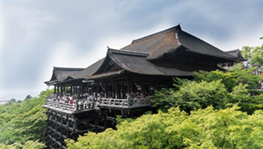 Kiyomizudera temple |
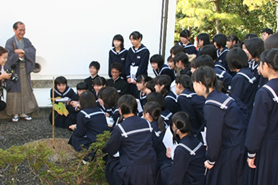 Kyo-Suzume Disaster Area Support, November 4, 2011, Ginkakuji Temple Welcoming students from Koyo Junior High School, Soma City, Fukushima Prefecture |
In recent years, research into the impact of prayer energy has been actively conducted in the United States and Europe. Professor Harvard Benson of Harvard University has confirmed that prayer has an effect on the suppression of breathing rate, heart rate, carbon dioxide emissions, and oxygen consumption, and is effective in treating illnesses such as cancer, diabetes, and infertility.
Japan has a culture not seen in other countries, such as cherry blossom viewing, which is a way of expressing gratitude to nature and offering prayers for the blessings of nature. Perhaps this is also thanks to Japan’s unique culture of harmony with nature. Although it may not seem related to earthquakes, it is interesting to consider the meaning of prayer in Japan, a country prone to earthquakes.
In Japan, the way humans are perceived has changed significantly between before and after the Meiji period. Originally, Japanese did not have the concept of separating nature and humans, and while the English word “nature” is translated into Japanese as “shizen,” the Buddhist term “jinen” was applied instead. Nature included humans as well.
The word “heating” was coined in 1897, when the Japanese did not have the concept of heating a room, but rather of warming people’s hands and feet. When you think about it, it’s a very eco-friendly idea. Kotatsu and braziers were used to warm people’s hands and feet, and in these days when people are calling for energy conservation, Japanese people’s lifestyles were very eco-friendly.
I would like to talk about the earthquake that occurred in and around Kyoto.
The first earthquake recorded in Japanese history was an earthquake that occurred in Asuka Village, Nara Prefecture in 418. Let’s take a look at the history of earthquakes below.
| 418
|
An earthquake occurred at Toasuka Palace (Yamato Province, present-day Asuka Village, Nara Prefecture). This was the first mention of an earthquake in the Nihon Shoki, and the first recorded earthquake in Japanese history. | ||
| 599 | Earthquake in Yamato Province, houses collapsed, first record of earthquake damage in “Nihon Shoki” | ||
| 684 | Nankai earthquake | ||
| 734
|
Kinai Seven Provinces Earthquake | ||
| 794
July |
Kinai Seven Provinces Earthquake | ||
| Sep. | Nankai earthquake causes damage to Kyoto again | ||
| Oct. | Heiankyo Kento | ||
| A year with many natural disasters, including the flooding of the Katsura River | |||
| 827
|
Tencho earthquake: M6, 5-7, aftershocks continue until the following year | ||
| 863 | Ecchu-Echigo Earthquake | 2004年 | Niigata earthquake |
| 864~866 | The great eruption of Mount Fuji and the great Jogan eruption also caused an eruption of Mount Aso | ||
| 868 | Hyogo earthquake | 1995 | Great Hanshin-Awaji Earthquake |
| 869 | Jogan earthquake | 2011 | Great East Japan Earthquake |
| 878 | Kanto earthquake | ? | A major earthquake directly beneath the capital |
| 887 | Nankai Earthquake | ? | Nankai Earthquake |
The three earthquakes, the Gangyo earthquake (Southern Kanto) in 878 and the Ninna earthquake (Nankai Trough Sanriku earthquake) in 887, occurred nine years apart.
The Eicho Tokai earthquake in 1096 and the Kowa Nankai earthquake in 1099 occurred consecutively, three years apart.
The Ninna earthquake (Nankai earthquake) on August 26, 887 (Ninna 3) caused many deaths, mainly in Kyoto and Settsu. The Tonankai and Tokai earthquakes also occurred at roughly the same time.
| 938 | May 22th Earthquake in Kyoto, killing four.
|
| 976 | July 22th (Teigen 1): Earthquake in Yamashiro and Omi, killing more than 50 monks and laypeople at Kiyomizu-dera Temple. |
| 1070 | Fences around houses in Kyoto collapse. The rope of the giant bell at Todai-ji Temple snaps. |
| 1185 | August 13th Bun’ei Kyoto earthquake, destroying Hossho-ji Temple, Kanshuji Temple, Enryaku-ji Temple, and Mii-dera Temple.
Bridges over the Uji River are damaged, and aftershocks continue for two months. Kamo no Chomei describes this in his “Hojoki.” |
| 1317 | The nine rings on the To-ji Temple pagoda break. The temple gates of Hossho-ji Temple and Hojo-ji Temple tilted.
A fire broke out at Kiyomizu-dera Temple, destroying its pagoda and bell tower |
| 1350 | he nine rings on the stone pagoda of Gion-sha Shrine fell. |
| 1449 | The embankments at To-ji Temple and Shinsen-en Garden collapsed, and the Buddha statue at Saga Seiryoji Temple and other structures toppled. |
| 1498 | the Meiō earthquake occurred consecutively, several months apart, in both the Tokai and Nankai regions. |
| 1596 | On September 1st an earthquake occurred in Beppu, Oita Prefecture, followed four days later by the Fushimi earthquake in the Keihanshin-Awaji region. Aftershocks continued until the spring of the following year, causing movement along the Takatsuki-Arima fault line. The castle tower and stone walls of Fushimi Castle were damaged, and Toji Temple, Tenryu-ji Temple, Daikaku-ji Temple, and Nison-in Temple collapsed, killing 45,000 people in Kyoto. |
| 1604年 | Great Nankai Earthquake |
| 1662 | On June 16, 1662 (May 1, 2nd year of the Kanbun era), an active fault moved. It is not clear which fault it was, but in Kyoto, 1,000 townhouses collapsed, over 200 people died, landslides occurred in Rokujizo and Kurama, and the embankment of Mukojima broke for over 550 meters. Moreover, the damage spread to Takatsuki, Osaka, and Amagasaki. |
The Genroku earthquake of 1703 (Southern Kanto) and the Hoei earthquake of 1707 (three consecutive earthquakes in the Nankai Trough) occurred just four years apart. 49 days after the Hoei earthquake, Mount Fuji erupted, causing devastating damage in Edo and the Kanto region.
The Great Bunsei Kyoto Earthquake occurred in August 1830 (Bunsei 13). Storehouses in and around Kyoto were destroyed, the Imperial Palace and the inner citadel of Nijo Castle were severely damaged, and 280 people were killed and 1,300 injured, according to “100 Years of Kyoto Weather.” There were 635 aftershocks until the following year, and no earthquakes have occurred in Kyoto since.
The end of document
Translated by Masami Otani
