
Special contribution to a love letter to Kyoto
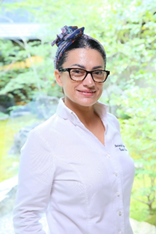
MARIANGELA RUGGIERO
CULINARY DIRECTOR
HILTON KYOTO
Kyoto is not a city that reveals itself at first glance.
It does not offer itself immediately; it unfolds slowly, like a quiet breath, with a grace that lingers like a subtle perfume.
I arrived in Kyoto after years spent in places that could not be more different—deserts, modern cities, and the wind-shaped coasts of the Mediterranean. And yet, no place had ever welcomed me with the same delicacy with which Kyoto settles into the soul: softly, respectfully, and with a quiet strength that never leaves you.
My life has always been made of flavors, gestures, and traditions.
Yet here, suddenly, I realized that cooking could be something else entirely:
a language of silence, of seasons, of balance.
Kyoto taught me to listen to things I had never truly heard before.
The fragility of a vegetable harvested at dawn.
The hush of an empty street at sunrise.
The ancient rhythm of a market that has survived centuries.
It taught me that simplicity is not an absence—it is a kind of purity.
In my cooking I carry the memory of my Italy—grandmothers’ kitchens, Sunday lunches, hands shaping dough while telling stories.
But every day, working with Kyoto’s ingredients, something deeper happens:
my roots meet the roots of this city.
It is a silent dialogue between two cultures that share the same respect for the land, for seasonality, and for the beauty hidden in small things.
I still remember the first time I tasted a local tomato:
it was a story.
A bouquet of herbs picked just hours earlier:
a poem.
The first time I met a Kyoto farmer:
a lesson in humility and devotion.
Kyoto has become not just a place to me, but a guide.
A reminder that cooking is, above all, an act of gratitude.
A place where I rediscovered that before creating, one must learn to listen.
And I listen when I walk.
Some of my clearest thoughts have come to me along the Kamogawa river, where the light changes with the seasons and the water carries away whatever is heavy.
When I need to reflect, I walk through the Botanical Garden, letting shapes, colors, and fragrances settle inside me until they become ideas.
And when I need inspiration for a new menu, I often go to Shimogamo Shrine.
There, under the tall trees, the silence feels ancient, and creativity arrives like a soft whisper from the forest.
Kyoto gave me back my silence.
It taught me to slow down, to observe more, to feel more deeply.
And it taught me that every season carries a gift, and every dish can become a bridge between distant worlds.
Today, when I cook for our guests at the hotel, I bring all of this with me:
my Italy and my Japan, my traditions and theirs, my story and Kyoto’s story.
And every dish I prepare becomes a small love letter—
to this city,
to the people who protect its beauty,
and to the quiet grace that Kyoto offers to those willing to listen.
Kyoto changed me.
It taught me to look more carefully, to listen more attentively, and to cook with respect and with heart.
For all this, I will always be grateful.
